The Technology
Harnessing Vortex Flow
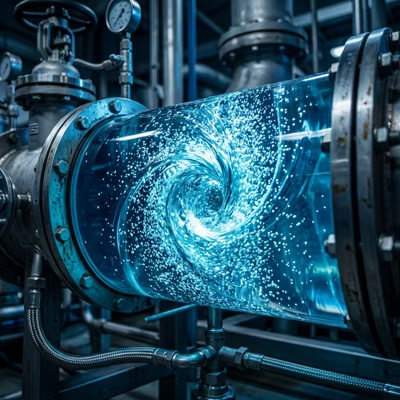
VORTA exploits rotational flow to create shear and control the energy of imploding bubbles. We contain the power of cavitation inside a vortex—solving the limitations of conventional devices.
Why It's Different
The Problem: Conventional Limitations
Conventional hydrodynamic cavitation devices (like orifice plates, venturis, and rotor-stators) struggle with industrial implementation. They suffer from clogging due to narrow restrictions, erosion from cavities collapsing on walls, and high OpEx due to linear flow pressure drops.
The Solution: VORTA Vortex Cavitation
VORTA innovates by using a tangential inlet to generate a high-velocity vortex. This design leverages the conservation of angular momentum to initiate cavitation at lower energy inputs. Crucially, the micro-bubbles collapse in the core of the vortex, away from the reactor walls, preventing erosion.
Core Advantages
VORTA solves the problems of scaling, erosion, and energy efficiency.
No Clogging
There are no small holes or narrow restrictions in VORTA. This allows for treating slurries containing suspended solids without blockage, ensuring consistency and more possibilities.
No Erosion
Micro-bubbles collapse in the vortex core, which is in the bulk of the liquid—not on the walls. This eliminates cavitation erosion, resulting in a significantly longer running life.
Enhanced Contact
Due to rotational flow, there is a massively enhanced contact of multiphase components in the stream. This leads to higher transformational efficiency.
Lower Energy
Conservation of angular momentum allows for early inception of microbubble-induced cavitation. This achieves the desired effect with lower pumping OpEx compared to linear flow devices.
Robust Design
No moving parts. No choking flow conditions (bubble cloud). This robust design translates to zero maintenance shutdowns and proven reliability.
Reliable & Scalable
Scaling up from lab to industrial scale is seamless. With over 30+ commercial installations (up to 20-50 m³/hr), VORTA is a proven green-tech solution.
The VORTA Process
Step 1: Vortex Generation
Feedstock enters tangentially, creating a strong rotational flow. This vortex motion is the engine of the VORTA technology.
Step 2: Low-Pressure Core
Conservation of angular momentum causes a pressure drop at the center of the vortex, initiating the formation of millions of vacuum micro-bubbles.
Step 3: Controlled Collapse
These bubbles implode violently in the vortex core. The energy of the collapse releases shockwaves and intense shear forces into the fluid.
Step 4: Process Intensification
The intense shear disintegrates biomass, increases surface area, and drives chemical reactions (like oxidation via OH• radicals), enhancing downstream output.
Common Questions
Is VORTA just another venturi device?
No. Venturi devices rely on linear flow constriction and are prone to clogging and erosion. VORTA relies on rotational flow (vortex) physics, which prevents clogging and contains cavitation away from the walls.
How does it save energy?
By exploiting angular momentum, VORTA achieves cavitation inception at a lower pressure drop than linear devices. This means you need less pumping power to achieve the same or better cavitation intensity.
What is the maintenance requirement?
Virtually zero for the reactor itself. Since there are no moving parts and no wall erosion, units have been running 24/7 for over 6 years without replacement.
Proven Commercial Success
See how VORTA has delivered consistent results in 30+ installations worldwide.