Boost Your Biogas Yield
VORTA pre-treats feed to unlock more methane from your existing digesters.Zero chemicals. Proven results.
Is your biogas plant leaving money on the table?
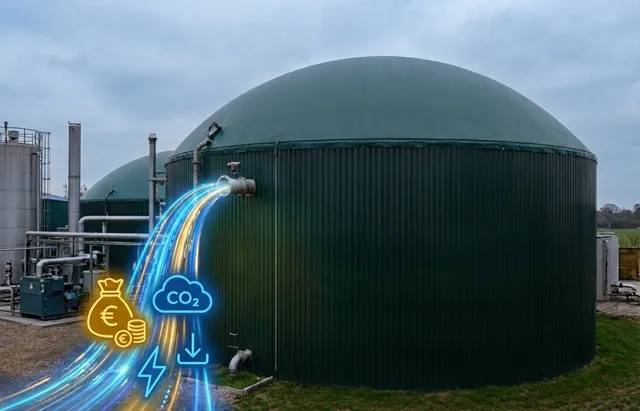
Standard anaerobic digestion (AD) leaves a large share of energy untapped. As much as 40 percent of the potential in your feed can pass through unconverted. This is what that loss looks like.
For every ton of untreated COD your plant is losing:
€400 in missed biogas value.
Small losses in COD conversion add up fast in daily gas revenue.
3.5 MWh of usable energy.
This is the fuel energy tied to one ton of COD that passes through unchanged.
0.7 tons CO₂ of avoidable emissions.
This is the carbon you could displace if that methane replaced fossil gas.
lower gate fees or lower profit.
Every unit of COD left unconverted reduces the business value you can capture.
Solution
VORTA improves biogas performance
VORTA's mechanical pretreatment overcomes the three key bottlenecks in anaerobic digestion—no chemicals, no complexity, just more biogas.
Hydrolysis (breaking down solids into soluble organics) is the slowest step in AD. It takes days for enzymes to break down solid particles. VORTA's pretreatment turns "solid food" into "soup," allowing bacteria to skip the hard work and start producing methane immediately.
Lignin structures often pass through the digester completely untouched. VORTA's pretreatment strips away these protective layers, exposing the digestible cellulose inside. This unlocks energy that was previously inaccessible, increasing your overall potential yield.
High-solid feedstocks create thick sludge that is hard to mix and prone to "dead zones" where no digestion happens. Vorta reduces the viscosity of the sludge. This ensures uniform mixing in the digester, eliminates thermal stratification, and reduces the parasitic load on your tank agitators.
Why VORTA?
Six Reasons Plants Choose VORTA
VORTA solves the problems that plague conventional cavitation devices. It delivers consistent, reliable performance at industrial scale.
Handles Any Feedstock
Conventional designs use narrow restrictions that clog easily. VORTA's unique design prevents clogging by allowing suspended solids to pass through freely. It handles slurries with solids, maintains consistent flow without choking, and ensures reliable operation 24/7.
Zero Erosion
Conventional devices suffer erosion when bubbles collapse on reactor surfaces. VORTA's vortex design contains bubble collapse in the liquid bulk, eliminating wall erosion entirely. Our longest-running installation has operated 24/7 since 2017 with no maintenance shutdowns.
Superior Contact Efficiency
Linear flow in conventional devices limits contact time between phases. VORTA's rotational flow creates intense shear and enhanced multiphase contact, dramatically improving mass transfer and transformation efficiency.
Low Energy
Conventional devices need higher pressure drops for same degree of cavitation. VORTA uses conservation of angular momentum to achieve cavitation at much lower energy input. This translates to significant operational cost savings.
Zero Maintenance Required
Rotor-stator designs involve moving parts that wear out and require regular maintenance. VORTA has zero moving parts, just fluid dynamics at work. This means no stator-rotor wear, no maintenance shutdowns, and no mechanical failures.
Biogas-Proven Technology
VORTA has been specifically proven in biogas applications across distilleries, dairies, and breweries. Installations consistently show 15-22% biogas yield increases, with our longest-running system operating continuously since 2017 without a single failure.
Testimonials
Trusted by Industry Leaders
Consistent biogas yield increases and significant operational savings across pharmaceutical, distillery, and chemical facilities since 2017.
" VORTA was commissioned for the purpose of biogas yield enhancement across the biodigester in our distillery. VORTA is in operation since April 2018 and is performing consistently to our fullest satisfaction. "

Baramati Agro
" VORTA was retrofitted in our plant in the year 2017 to pre-treat the feed to the biodigester in our plant. VORTA is performing consistently that resulted in an overall increase of 15% more biogas yield. "

Jubilant Pharmova
" We commissioned VORTA for the purpose of effluent treatment for our waste water treatment plant. VORTA is in operation since April 2017 and is performing to our fullest satisfaction. "

Alkyl Amines
" VORTA Technology was installed in our plant in March 2019 and since that it has helped to consistently enhance the biogas yield from our spent wash digesters by more than 10%. "

Dhampur Bio Organics Limited
" VORTA reactor rated at 20 m³/hr was installed in our distillery in April 2020 and it consistently demonstrated an increased enhancement of 17+% in biogas yield from our Anaerobic Digestor. This saved us 7 tons per day of bagasse at the boilers. "

Vasantdada Sugar Institute
Partnerships & Collaborations
At VORTA, we believe in the power of collaboration to drive innovation and create exceptional experiences.










Other applications
VORTA is not just for biogas
VORTA can be used in other applications beyond biogas production.
VORTA's cavitation generates hydroxyl radicals (OH•) that decompose pollutants through advanced oxidation, offering a chemical-free retrofit solution for industrial wastewater treatment plants.
VORTA's cavitation produces emulsions with controlled droplet size distributions, reducing diameter by orders of magnitude in food, cosmetics, and chemical processing.
VORTA's shear forces and turbulence enable controlled nucleation and mass transfer, resulting in crystal purity, faster growth rates, higher yields, and reduced cycle times.
VORTA's cavitation breaks down long-chain molecules to reduce viscosity in crude oil, food processing, and chemical manufacturing, improving efficiency and reducing energy use.
VORTA's cavitation creates intense temperature and pressure, and overcomes mass transfer limitations, accelerating reaction rates in oxidation, reduction, hydrolysis, and polymerization reactions.
VORTA's shockwaves break down plant cell walls for extraction applications like CBD oil, offering a clogging-free alternative to solvent or CO₂ methods with maximized efficiency per unit energy.
FAQs
Frequently Asked Questions
Does VORTA affect digester stability?
VORTA pretreatment can improve conditions that support stable digester operation. By reducing particle size and viscosity, it improves pumpability and mixing. This lowers the risk of dead zones, stratification, and local overloading. In many cases it also increases soluble COD, which makes substrate more accessible to microbes and can smooth gas production when loading is controlled.
VORTA tends to support stable operation when integrated correctly, but it does not replace good digester control.
Can VORTA be retrofitted to an existing plant?
Yes. VORTA is designed to be retrofitted into existing plants.
It is installed as an inline pretreatment unit on the feed line, typically upstream of the digester or holding tank. No changes to the digester itself are required. The unit has no narrow restrictions, so it can handle slurries with suspended solids and existing particle size distributions.
Integration usually involves a bypass loop, isolation valves, and a dedicated pump sized for the required flow and pressure. Footprint is small, and the unit can be skid mounted and commissioned without shutting down the plant.
How much energy does VORTA consume?
VORTA has a low specific energy demand compared to other pretreatment options.
Typical consumption is in the range of about 1 to 10 kWh per m³ of slurry processed. The exact value depends on feed characteristics, solids content, and the operating window selected for the trial or plant.
In most biogas applications, the additional methane produced more than offsets the electrical input, so the net energy balance remains positive.
What maintenance is required?
The VORTA unit itself has no moving parts. There are no rotors, stators, valves, or narrow orifices inside the cavitation device, so there is no routine wear component to replace.
Because cavitation collapse occurs in the vortex core and not on solid surfaces, erosion of the device is not observed in normal operation. Units in continuous service run 24 by 7 with no internal refurbishment.
In practice, maintenance effort is dominated by the pump and instrumentation, not by the VORTA reactor itself.