· VORTA Team · Process Streams · 2 min read
Perfecting Emulsions through Vortex Cavitation
Discover how VORTA is revolutionizing emulsion production in food, healthcare, and cosmetics by harnessing vortex-based hydrodynamic cavitation for precise droplet size control.
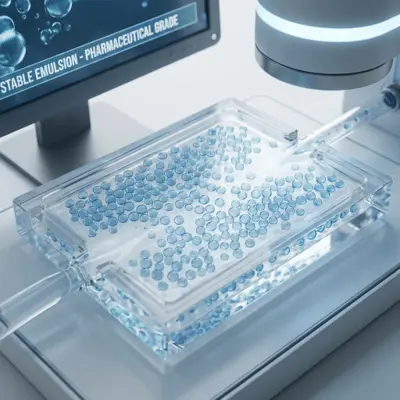
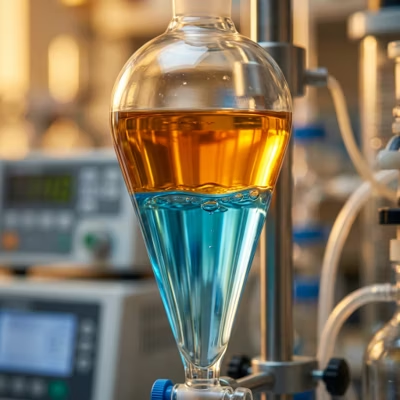
Liquid-liquid emulsions are the backbone of multiple industries, from food and healthcare to cosmetics and chemical processing. The quality of an emulsion largely depends on the droplet size distribution (DSD), which influences factors like rheology, appearance, and stability. Traditional methods such as high-pressure homogenizers and rotor-stators have been effective but not without their limitations. By harnessing hydrodynamic cavitation, VORTA offers a novel approach to creating emulsions that meet desired critical quality attributes (CQA).
The Power of Vortex Cavitation
Hydrodynamic Cavitation (HC) is a fascinating phenomenon where vapor cavities are generated, grown, and collapsed. This process leads to intense localized shear and high-velocity jets, which are prime conditions for breaking down oil droplets in a water medium, thereby forming emulsions.
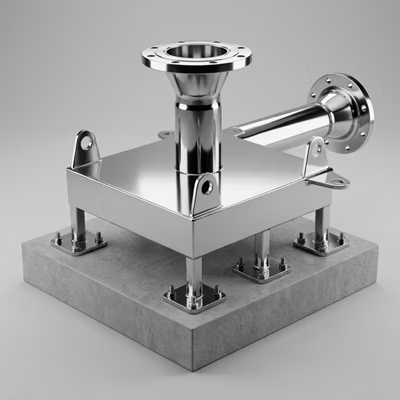
Traditional linear flow devices have limitations like high inlet pressure requirements and less control over the resulting DSD. VORTA overcomes these challenges by generating swirling flow without moving parts, making it efficient and less prone to erosion.
Key Research Insights
A recent study [1] highlights this innovative method to produce emulsions using a rapeseed oil–water system. Major findings include:
- Excellent Drop Breakage: Vortex cavitation demonstrated superior performance, reducing droplet diameter by two orders of magnitude with minimal energy input.
- Consistency: The drop size distribution (DSD) and Sauter mean diameter (d₃₂) showed self-similarity across different operating conditions.
- Localized Breakage: Most of the drop breakage occurred inside the vortex chamber, primarily in the cavitation core.
- Optimization: With proper optimization, vortex cavitation can produce emulsions with exactly the desired DSD.
Advantages of VORTA
- Precision: Allows for a controlled and predictable droplet size distribution.
- Efficiency: Capable of achieving high degrees of droplet breakage in a single pass.
- Versatility: Applicable at both laboratory and industrial scales.
- Low Operational Constraints: Works without requiring high inlet pressures or moving parts, making it less prone to mechanical failures.
References: [1] Thaker, Abhijeet H., and Vivek V. Ranade. 2022. ‘Towards Harnessing Hydrodynamic Cavitation for Producing Emulsions: Breakage of an Oil Drop in a Vortex Based Cavitation Device’. Chemical Engineering and Processing – Process Intensification 180 (October): 108753. https://doi.org/10.1016/j.cep.2021.108753.